Blogs
Discover the latest insights, guides, and updates on AI orchestration, real-time systems, and modern event-driven communication with DNotifier.
Bedrock on DNotifier: Setup Guide
Part one of the DNotifier × AWS Bedrock series — enable models in your AWS account, connect IAM or keys in the portal, and call Nova and other Bedrock models through sendAI().
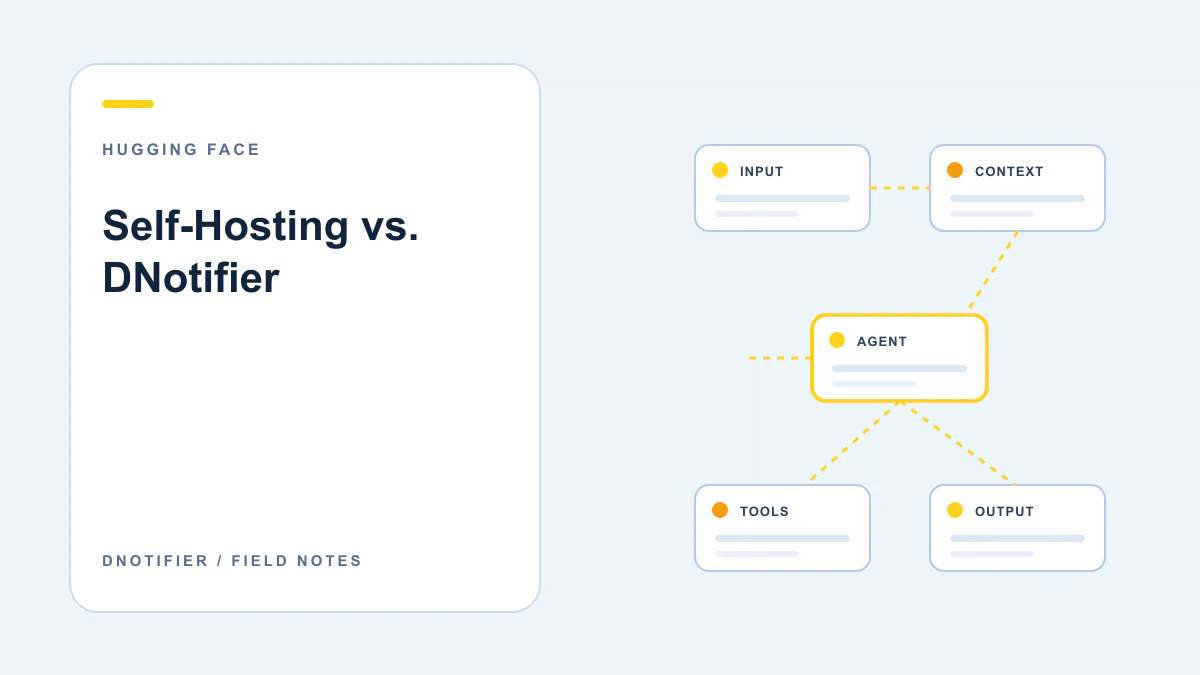
Self-Hosting vs. DNotifier
Part ten of the DNotifier × Hugging Face series — the full cost of running your own inference stack versus hosted APIs and orchestration that stays the same either way.
Hugging Face for Regulated Industries
Part nine of the DNotifier × Hugging Face series — SOC 2, GDPR, Hub governance, paid-tier audit logs and BAAs, and separating model capability from compliance posture.
Hugging Face Spaces, Explained
Hugging Face Spaces hosts Gradio and Streamlit demos. See what Spaces is good for, where it breaks under production traffic, and what to use instead.
Picking an Open Model: A Guide
Pick an open model by task first, then size, license and quantization. A shortlist-then-test workflow for choosing open-weight LLMs on Hugging Face.
Building a Model-Router Agent
Part six of the DNotifier × Hugging Face series — classify request complexity and route to sized models with defineAgent, Workflow, and Inference Providers routing hints.
Smolagents vs. DNotifier
Part five of the DNotifier × Hugging Face series — code-as-action agents versus structured workflows, sandbox risk, and where each orchestration layer fits.
Inference Providers vs. Endpoints
Inference Providers bill per call on shared serverless capacity; Inference Endpoints give you dedicated hardware. Compare cost, cold starts and when each fits.
Inside Hugging Face's Model Explosion
Part three of the DNotifier × Hugging Face series — what three million Hub models actually means, where the signal is, and how to filter noise into a shortlist.